
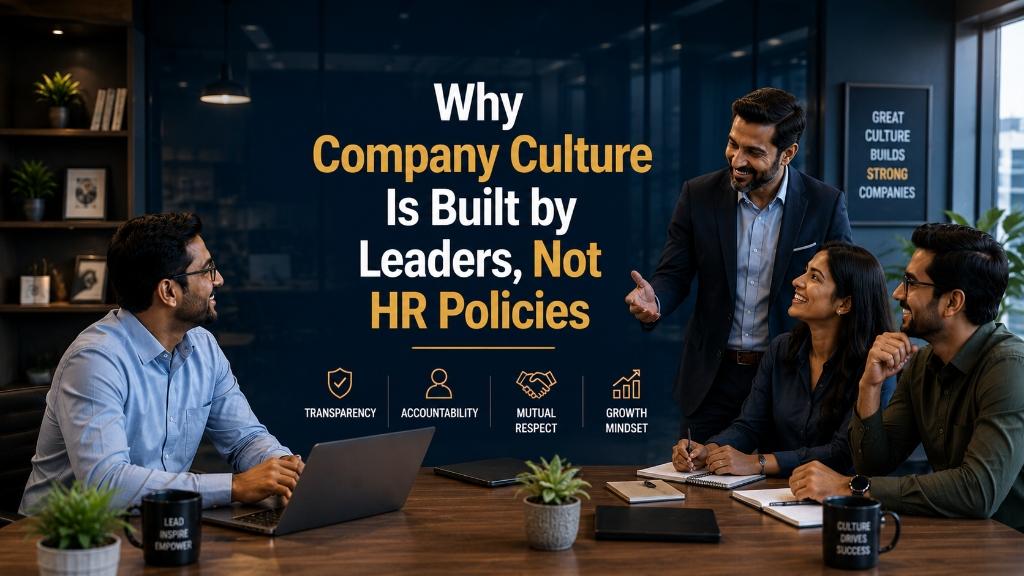
If you walk into almost any modern corporate office, you will find posters on the walls listing corporate values like “Integrity,” “Innovation,” “Respect,” and “Customer First.” You will be handed a detailed employee handbook created by the HR department outlining policies, dress codes, and standard procedures.
Yet, in many of these organizations, the day-to-day reality is completely different. Employees are hesitant to speak up, departments work in silos, and decisions are made behind closed doors.
This disconnect happens because of a fundamental misunderstanding: Company culture is not built by HR policies. Company culture is built by the behavior of its leaders.
Culture is not what you write on posters; it is how you behave when nobody is watching. It is caught, not taught.
In this article, we will explore the difference between policy and reality, look at the four core pillars of a leader-driven culture, and explain how leading by example shapes a highly successful business.
The Illusion of HR Policies vs. Leadership Reality
HR policies define the rules, but leaders define the actual norms of the company. When there is a conflict between what is written in the handbook and how the leader acts, employees will always follow the leader’s behavior.
Consider these common examples:
- Work-Life Balance: An HR policy may promote mental wellness and work-life balance. But if the business owner or manager regularly sends emails at 10:00 PM and expects immediate responses, the real culture is one of constant availability and burnout.
- Open Communication: A company might hold workshops on the importance of feedback and open communication. But if a leader reacts defensively, penalizes team members who disagree, or ignores suggestions, the real culture becomes one of fear and silence.
- Customer Obsession: The company slide deck might say "the customer is our number one priority." But if leaders consistently cut corners on product quality to meet short-term financial targets, the team learns that short-term profits are what actually matter.
Employees are highly observant. They quickly learn what is rewarded and what is penalized by watching the leaders.
The Four Pillars of a Leader-Driven Culture
Based on my two decades of experience working with diverse teams and businesses, building a healthy, high-performance culture relies on four foundational pillars that leaders must model daily:
1. Transparency: Building Partnership, Not Just Compliance
A leader must share the "why" behind major business decisions. When team members understand the company's financial goals, market challenges, and long-term vision, they feel like true partners in the business rather than just cogs in a machine.
2. Accountability: Holding Everyone to the Same Standard
Culture is defined by the worst behavior a leader is willing to tolerate. A leader must hold themselves to the highest level of accountability. If you make a mistake, admit it openly. When your team sees you taking responsibility for your errors, it creates a safe space for them to do the exact same.
3. Mutual Respect: Valuing Input, Not Just Designations
A high-performance culture is one where ideas win, regardless of who they come from. Leaders must treat every team member with respect, actively listen to their perspectives, and value their unique contributions.
4. A Growth Mindset: Framing Mistakes as Learning Tools
If you punish every mistake, your team will stop taking risks. They will stick to safe, mediocre paths, which kills innovation. A great leader frames failures as valuable experiments, helping the team learn and adapt for the next attempt.
How to Lead by Example (Caught, Not Taught)
If you want to shape a positive culture in your business, start with these two practices:
- Your Calendar Tells the Truth: What you spend your time on shows your team what you truly value. If you want a culture of customer focus, spend time speaking with customers and reviewing feedback, not just analyzing internal reports.
- Celebrate the Right Behaviors: Don't just reward the salesperson who brought in the highest revenue. Celebrate the employee who went out of their way to help a colleague, the one who showed extreme transparency during a project failure, or the manager who successfully delegated ownership. Shifting from a bottleneck approach to a scalable founder mindset is what allows a positive culture to take root.
Final Thoughts
HR departments do a vital job in setting up structures, managing compliance, organizing training, and handling benefits. But they cannot force a culture into existence. According to organizational insights by McKinsey & Company, culture is modeled and sustained through daily behaviors, leadership reinforcement, and operational symbols, not policy manuals.
Your company culture is a direct reflection of your leadership. If you want a culture of trust, you must extend trust first. If you want a culture of accountability, you must hold yourself accountable first.
The culture of your organization starts with you.