
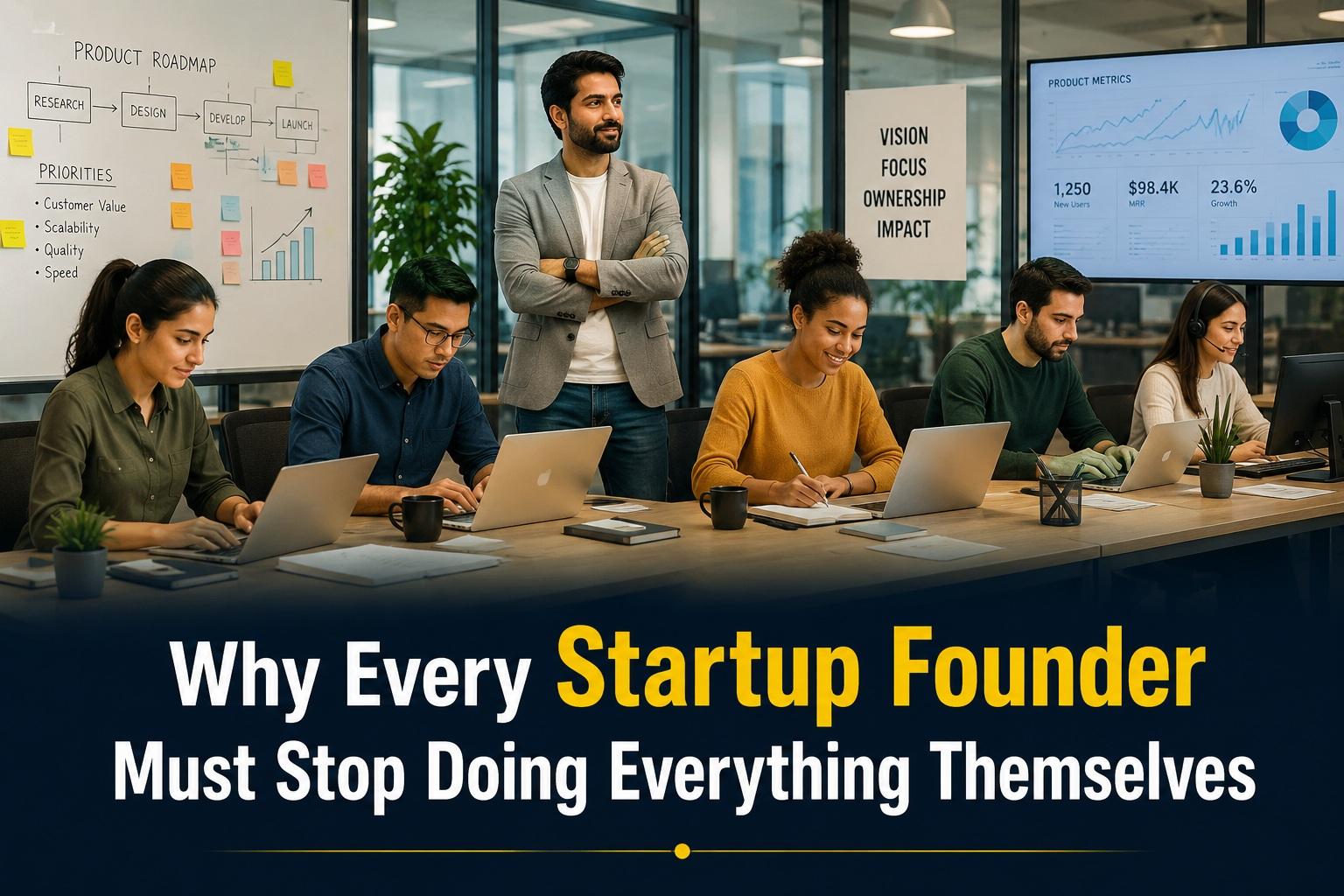
Every startup begins with a founder who is willing to do whatever it takes to turn an idea into reality. In the early days, founders often handle product development, customer support, sales, hiring, operations, and business development simultaneously. This level of involvement is sometimes necessary because resources are limited and the company is still finding its direction. However, what helps a startup survive in its early stage can become the biggest obstacle to its growth later. One of the most common mistakes I have observed among startup founders, business leaders, and entrepreneurs is their desire to do everything themselves. They believe that staying involved in every decision, every task, and every conversation will ensure quality and speed. In reality, the opposite often happens. As the company grows, the founder becomes the bottleneck, the team becomes dependent, and progress begins to slow down. The real challenge for a founder is not building the product alone. The real challenge is building a team that can help the company grow beyond the founder's individual capacity.
Why Founders Try to Do Everything Themselves
Most founders do not intentionally create dependency. It usually begins with good intentions. They care deeply about the product. They understand the vision better than anyone else. They want customers to have the best possible experience. They also fear that mistakes made by team members could affect the company's reputation. As a result, founders review every proposal, approve every feature, attend every meeting, and make every important decision. Initially, this approach may seem efficient because the founder can move quickly without waiting for others. The problem begins when the startup starts growing. New employees join the company. Customers increase. Product requirements become more complex. Operational responsibilities expand. At that point, one person's capacity is no longer enough to support the organization's growth. Unfortunately, many founders continue operating exactly as they did when the company had only a few employees. What worked for a team of three rarely works for a team of fifteen.
The Hidden Cost of Founder Dependency
A founder-dependent organization creates several problems. The first problem is slower decision-making. When every decision requires founder approval, employees stop taking initiative. Team members begin waiting for instructions rather than solving problems independently. The second problem is reduced ownership. People naturally take ownership when they are trusted to make decisions. If every action is controlled by the founder, employees eventually conclude that their role is simply to execute instructions. The third problem is founder burnout. Many startup founders complain that they work long hours every day and still feel that important work remains unfinished. In many cases, the issue is not the amount of work. The issue is that the founder has become involved in activities that should be handled by other people. A startup cannot scale if every important decision depends on the founder.
Ownership Cannot Exist Without Authority
One of the biggest misunderstandings in startup management is the concept of ownership. Many founders tell employees to take ownership of their work. However, ownership cannot exist without authority. Imagine assigning a product feature to a developer but requiring approval for every design choice, technical decision, and implementation step. The developer is responsible for delivering the feature, but does not have the authority to make meaningful decisions. In such a situation, true ownership never develops. Responsibility and authority must grow together. When employees are given clear objectives, decision-making boundaries, and the freedom to execute within those boundaries, they begin thinking like owners rather than task executors. This does not mean giving unlimited freedom. It means creating a framework where people know what they are responsible for and what decisions they are empowered to make. Ownership grows when responsibility and authority grow together.
Why Hiring the Right People Matters More Than Hiring More People
Many startups focus on increasing team size as they grow. However, hiring more people does not automatically solve management problems. In fact, hiring the wrong people often creates additional work for the founder. A startup benefits most from individuals who can think independently, solve problems proactively, and take accountability for results. Technical skills are important, but ownership mindset is equally important. The right team members do not simply ask what needs to be done. They identify problems, propose solutions, and take responsibility for execution. When founders hire people who can be trusted with responsibility, delegation becomes much easier. The goal should not be to build a large team. The goal should be to build a capable team.
Systems Create Consistency
As startups grow, founders cannot rely solely on individual effort. Systems become essential. Systems do not need to be complicated. In many cases, simple processes are enough. Clear responsibilities, documented workflows, communication guidelines, review mechanisms, and defined decision-making authority can significantly improve execution. The purpose of systems is not to create bureaucracy. The purpose of systems is to create consistency. When systems are in place, work continues even when the founder is focused on customers, product strategy, fundraising, or business development. Without these, organizations become dependent on individual people. With proper business systems, organizations become capable of scaling independently.
How Founders Should Respond to Mistakes
Many founders struggle with delegation because they fear mistakes. The reality is that mistakes are inevitable. Even experienced professionals make errors. The question is not whether mistakes will happen. The question is how the founder responds when they do. Some founders immediately take back control after an employee makes a mistake. While this may solve the immediate issue, it creates long-term dependency. Employees become hesitant to make decisions because they fear losing responsibility. A more effective approach is coaching. Founders should help team members understand what went wrong, improve the process, clarify expectations, and ensure that lessons are learned. Every mistake is an opportunity to improve a system, not a reason to centralize control. Organizations grow when people learn from mistakes and become stronger because of them.
The Real Role of a Startup Founder
As a startup grows, the founder's role must evolve. The founder should remain deeply involved in critical decisions, company vision, product direction, hiring key talent, and strategic planning. However, the founder should not become involved in every operational activity. The highest value a founder creates comes from building the right team, assigning the right responsibilities, and maintaining confidence in the company's vision. As discussed in Forbes' sections on leadership, shifting from a doer to a facilitator is a founder's hardest but most rewarding transition. A founder adds the most value when the right people are assigned to the right tasks. Leadership is not about doing all the work. Leadership is about creating an environment where great work can happen without constant supervision.
Final Thoughts
Every successful startup begins with a founder who is willing to work hard. However, long-term growth requires more than hard work. It requires trust, delegation, systems, and the ability to build a team that shares responsibility for success. Founders who try to do everything themselves eventually limit the growth of their own organizations. Those who hire capable people, create clear ownership, establish systems, and empower decision-making build companies that can grow far beyond their individual efforts. The goal of a startup founder should not be to become indispensable. The goal should be to build a company that can continuously execute, innovate, and grow because ownership exists throughout the organization. Ultimately, startups scale faster when founders stop trying to do everything themselves and start building teams that can grow with the vision.