
As businesses adopt artificial intelligence, a common bottleneck emerges: standard AI models do not know anything about your specific company. They do not know your shipping guidelines, your custom customer service protocols, or your internal software configurations.
To overcome this, forward-thinking organizations are implementing rag for business data. Retrieval-Augmented Generation (RAG) is a technology that connects AI models to your private database, allowing your team to query internal files and receive accurate, context-aware answers instantly.
By giving your team access to these tools, you can dramatically improve operational efficiency and save hours of searching through nested folders.
What is RAG and How Does It Work?
Retrieval-Augmented Generation sounds complex, but its core concept is simple. It acts as an automated search assistant for your company's documents.
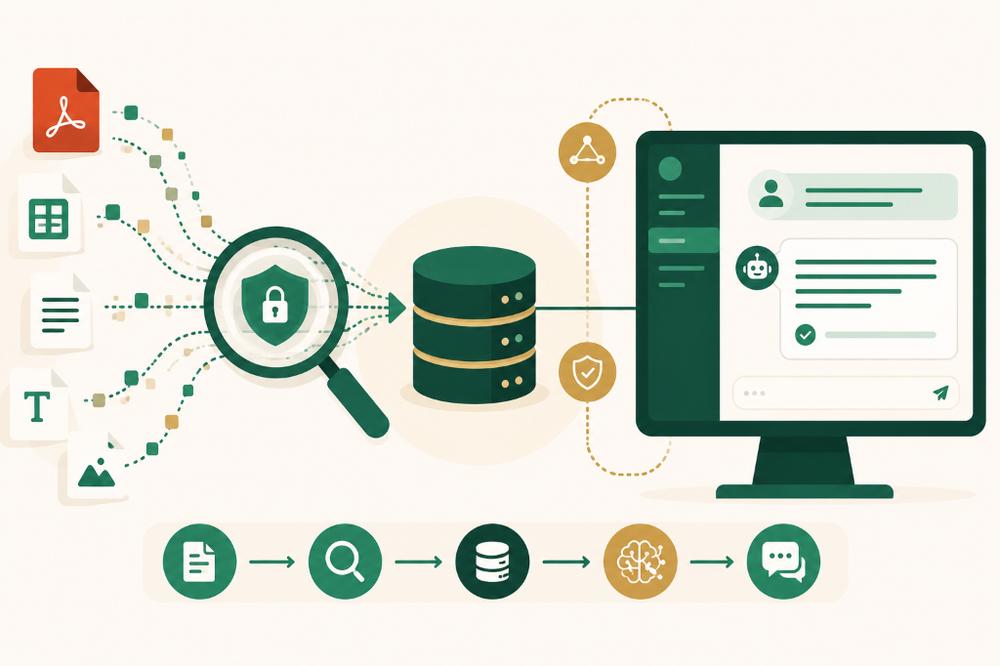
Instead of retraining or fine-tuning an expensive AI model from scratch, RAG works in three steps:
- Retrieval: When an employee asks a question, the system searches your preloaded company documents (PDFs, spreadsheets, slide decks, or text files) for the most relevant sections.
- Augmentation: The system bundles the query with these retrieved text sections, creating a rich package of context.
- Generation: The AI model reads this specific context and generates a precise answer, citing the exact document it used as a source.
This ensures the AI's responses are grounded in your actual business policies, drastically reducing the risk of "hallucinations" (where the AI makes up incorrect information).
The Productivity Payoff: Saving Time and Reducing Friction
The primary benefit of deploying RAG for business data is the massive amount of time it saves your team.
In any standard small business, employees spend hours searching through shared drives, internal wikis, and chat histories to find simple answers. For example, a customer support agent might need to verify a return policy, or a new salesperson might need to double-check product specifications.
With a RAG-powered internal assistant, these employees can simply ask: "What is our policy on returning defective items after 30 days?" or "What are our standard sales commission brackets?" The AI retrieves the relevant sales commission structure guide or company SOP and answers in seconds, saving valuable time and keeping your operations moving smoothly.
Secure Implementation for Small Businesses
A major concern for business owners when adopting AI is data security. You cannot simply upload your sensitive customer databases, financial sheets, or proprietary SOPs to public LLMs, as that risks data leaks.
Fortunately, implementing RAG for business data can be done securely and cost-effectively:
- Private Environments: By using frameworks like LangChain or LlamaIndex, you can build RAG systems that run in private cloud environments or locally on your company servers.
- Access Control: You can set strict user permissions so the AI only retrieves documents that the querying employee is authorized to see (e.g., preventing general staff from querying payroll documents).
- Low-Cost Tooling: You do not need a massive enterprise budget. Small businesses can set up highly effective vector databases (like ChromaDB or Qdrant) combined with open-source models to build custom assistants cheaply.
This secure approach matches the safety standard you would use when setting up a general AI policy for employees.
Final Thoughts
Implementing RAG for business data is one of the most practical ways small businesses can leverage AI today. By connecting an LLM to your own secure document database, you create a powerful, accurate assistant that answers team questions instantly. This reduces search friction, boosts daily productivity, and keeps your private data safe—allowing you to run a faster, smarter, and more efficient business.