
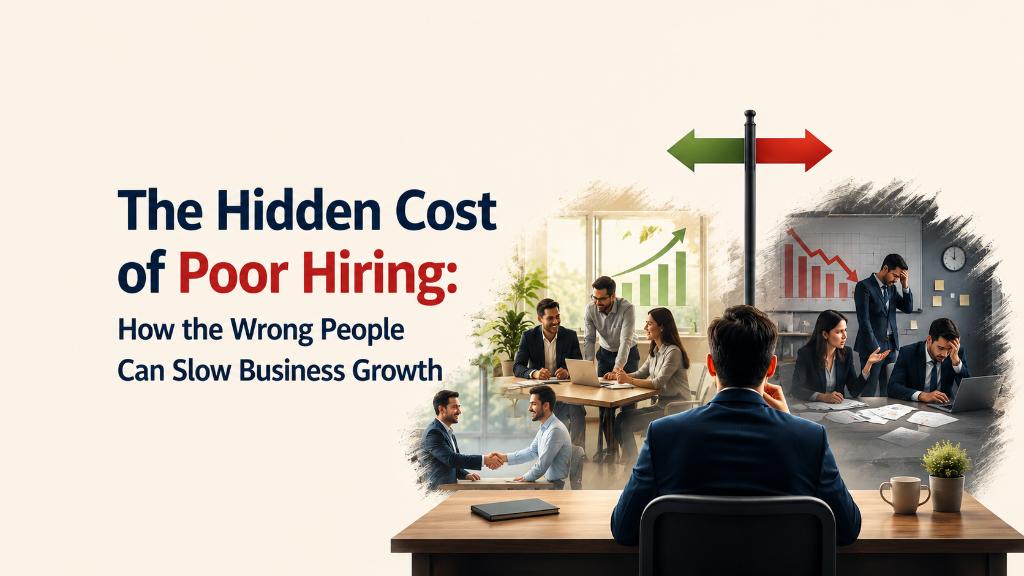
Most business owners believe that hiring the wrong employee simply means paying a salary to someone who doesn't perform.
In reality, the cost is much higher.
A poor hiring decision can waste months of your time, damage customer relationships, reduce team morale, slow business growth, and even affect your company's reputation.
After spending more than 20 years in industrial sales, business development, and leadership roles, I have learned that hiring is one of the most important decisions any business owner makes. The right employee can accelerate growth, while the wrong one can quietly hold the entire organization back.
Hiring Is More Than Filling a Vacancy
One of the biggest mistakes companies make is hiring because there is an immediate vacancy.
The thought process is simple: "We need someone quickly."
Unfortunately, speed often replaces judgment.
Before starting the recruitment process, every business owner should answer three important questions:
- What exactly is the role?
- What responsibilities will this person handle?
- What qualities are essential to succeed in this position?
Many companies clearly define the job responsibilities but fail to identify the qualities needed to perform the role successfully. This often leads to poor hiring decisions.
One Lesson I Learned the Hard Way
One experience taught me a valuable lesson.
We once recruited a Sales Engineer through an online interview for the Chhattisgarh region. Based on the virtual interview, the candidate appeared suitable and was appointed.
However, when I met him personally for the first time, I immediately realized he was not the right fit for the role.
The interview had assessed his answers but not his overall personality, confidence, and presence.
That experience reinforced an important lesson for me:
Whenever possible, meet candidates personally before making a final hiring decision, especially for customer-facing roles like sales and business development.
Why Interviews Alone Are No Longer Enough
Today's candidates are well prepared.
They know the common interview questions.
They know what recruiters expect to hear.
As a result, traditional interviews often reveal how well someone has prepared rather than how they will perform on the job.
Instead of relying only on theoretical discussions, interviewers should focus on practical situations.
Ask candidates how they handled difficult customers. Discuss real business scenarios. Understand how they think, solve problems, and communicate under pressure.
The objective is not to test memory. It is to understand behaviour.
Skills Can Be Learned: Attitude Is Different
When evaluating candidates, I usually focus on five qualities:
- Attitude
- Communication skills
- Technical knowledge
- Customer focus
- Discipline
Technical skills are undoubtedly important, especially in industrial businesses.
However, attitude is the one quality that is extremely difficult to change after hiring.
A motivated employee can improve technical knowledge through training.
But changing someone's mindset, work ethic, or willingness to learn is far more challenging.
That is why businesses should never ignore attitude during the hiring process.
The Real Cost of a Wrong Hire
Most people calculate hiring costs only in terms of salary.
According to benchmarks established by the Society for Human Resource Management (SHRM), a bad hire can cost an organization up to five times their annual salary when accounting for recruitment, onboarding, and lost productivity. The actual cost to a growing business is much greater.
A wrong hire can result in:
- Loss of valuable management time
- Reduced productivity
- Customer dissatisfaction
- Missed business opportunities
- Increased pressure on high-performing employees, which often leads to burnout and compromises your broader employee retention strategies
- Delayed business growth
In customer-facing roles, the impact becomes even greater.
Although I have not personally lost a customer because of an employee's mistake, I have seen customers become disappointed when the wrong person was responsible for handling their account.
Trust takes years to build and only a few poor interactions to weaken.
Why Business Owners Make Hiring Mistakes
From my experience, poor hiring decisions usually happen because business owners are in a hurry.
A vacancy creates pressure.
Targets must be achieved. Customers need support.
Instead of finding the right person, companies focus on finding the fastest available person.
Another common mistake is failing to define the qualities required for the role.
Hiring should never begin with resumes.
It should begin with clarity.
What Should You Do If You Hire the Wrong Person?
Not every hiring mistake requires immediate termination.
The first step is to coach and guide the employee.
Sometimes people simply need better direction.
If their strengths lie elsewhere, consider assigning responsibilities that better match their capabilities.
However, if repeated coaching produces no improvement and the role continues to suffer, delaying the decision only increases the cost to the business.
Sometimes the most responsible leadership decision is to part ways professionally and respectfully.
Advice for First-Time Entrepreneurs
If you are hiring your first employee, my advice is simple.
First, have complete clarity about the role.
Second, identify the qualities required to perform that role successfully—not just the qualifications.
Third, focus more on practical ability than theoretical knowledge.
A strong resume may get someone into the interview.
Their attitude, problem-solving ability, and willingness to learn determine whether they will contribute to your business.
Final Thoughts
People are one of the greatest assets in any business.
Technology can improve efficiency. Systems can improve consistency. Processes can improve productivity.
But ultimately, people execute every business strategy.
The quality of your team determines the quality of your customer experience, your sales performance, and your long-term growth.
Before making your next hiring decision, slow down and ask yourself three simple questions:
- Is the role clearly defined?
- Have I identified the qualities required for success?
- Am I hiring for long-term value rather than short-term urgency?
Getting these answers right may save your business far more than the salary you are trying to fill.
Because in business, the hidden cost of poor hiring is rarely visible on the balance sheet—but it is almost always visible in the company's growth.